Horses age differently from people: their early years pass quickly and then the rate slows, so converting horse years to human years is an estimate that helps owners set care expectations, training plans, and health monitoring. This guide explains simple formulas, an easy reference chart, and practical ways to gauge an individual horse’s equivalent human age using physical signs like teeth.
You will learn step-by-step calculation methods, a compact conversion table for quick lookups, the main factors that shift lifespan and equivalencies, and reliable dental indicators to refine estimates. Practical lists and tables help you apply the conversions to foals, adolescents, adults, and senior horses while noting common myths such as the multiply-by-seven rule. Read on for concise examples, conversion tools, and short actionable care tips tied to life stages so you can match management strategies to your horse’s “human” age.
How Do You Calculate Horse Years to Human Years?
Calculating horse years to human years uses two principles: accelerated maturation in the first few horse years and slower aging thereafter, which together create stepped multipliers for conversion. A common, practical approach treats the first 1–2 horse years as worth roughly 6–7 human years each, with subsequent years counting for about 2–3 human years; this balances developmental milestones against later-life slowing.
These rules yield useful approximations for training readiness, behavioral expectations, and age-related care planning, though they remain estimates that require adjustment for breed and health. Below we show standard formulas and an illustrated example that convert a 5-year and a 20-year horse into human equivalents to demonstrate the method.
What Are the Standard Formulas for Horse to Human Age Conversion?
This subsection outlines commonly used formulas and how to apply them in practice so you can convert any horse age into a reasonable human equivalent. Use the stepped multiplier method as a practical default: count the first 1–2 horse years as ~6.5 human years each, then add ~2.5 human years for each additional horse year. These values reflect rapid early development (to skeletal and sexual maturity) followed by slower physiological aging, which is why simple linear “multiply-by” rules usually mislead. The short example below shows the calculation process and clarifies when to choose each multiplier.
The most used formulas in practice:
- Staged multiplier: First horse year = ~6.5 human years; second year = ~6.5 human years; each subsequent year = ~2.5 human years.
- Simplified average: Treat early 0–4 years as accelerated (~5–7 human years per horse year), then ~2.5 thereafter for adult-to-senior mapping.
- Chart lookup: Use an age-equivalent table (below) for quick reference when precision matters more than formula derivation.
Apply these by summing the staged values for the horse’s age; for example, a 5-year-old horse ≈ (6.5 + 6.5 + 2.5 + 2.5 + 2.5) ≈ 20.5 human years, indicating young-adult equivalence.
How Does Early Horse Development Affect Age Conversion Rates?
Early horse development drives the steep initial slope of conversion because foals and yearlings reach physical maturity far faster than human infants and children. Key milestones—such as incisor eruption, weaning, and fusion of major growth plates—happen within months to a few years and align with human childhood and adolescence in functional terms, which is why the first horse years map to disproportionately larger human-year equivalents.
Recognizing these milestones helps owners set training, nutrition, and socialization expectations that match developmental readiness rather than chronological years. Understanding early maturation also explains why dental aging and growth-plate assessment offer more precise age checks in young horses, and this insight leads directly to using conversion charts and dental cues together for accuracy.
What Is the Horse Age Chart for Human Year Equivalents?
A concise conversion chart gives a quick way to map common horse ages to human equivalents for everyday decisions like training stage, workload, and preventive care scheduling. The table below condenses staged-multiplier logic into a glanceable reference that pairs ages with short developmental notes so you can interpret what each equivalent means for behavior and management. After the table, a short explanation explains how to read mid-year ages and when to prefer dental or veterinary assessment for precise aging.
Different horse life stages convert approximately as shown in the table below:
| Horse age (years) | Human equivalent (years) | Developmental notes |
| 0 (foal) | 0–1 | Neonatal growth, dependence, rapid weight gain |
| 1 | 6–7 | Juvenile / toddler stage, weaning, basic handling |
| 2 | 12–13 | Adolescent, early training readiness, continuing growth |
| 5 | ~20–21 | Young adult, full skeletal maturity likely reached |
| 15 | ~50–55 | Mature adult, peak performance years in many disciplines |
| 20 | ~65–70 | Senior range, increased risk of age-related conditions |
This chart synthesizes staged multipliers into practical equivalents that work for quick decisions; remember that breed, workload, and health will shift any individual horse’s placement and may require vet assessment for precise planning.
How to Read the Horse Age to Human Age Conversion Chart?
Reading the chart is straightforward: look up the horse’s nearest completed year, apply the human equivalent shown, then adjust for mid-year ages or known developmental markers when needed. For a horse aged 3.5 years, interpolate between the 3- and 4-year equivalents or use the staged calculation method to add half a year (roughly +1–1.5 human years in early development).
If precise age matters (e.g., purchasing, retirement planning), prioritize a dental exam or radiographic growth-plate check over chart interpolation. Use the chart as a first pass and move to vet-based age verification when health, treatment, or legal matters depend on exact age.
What Are the Human Age Equivalents for Each Horse Life Stage?
Mapping life stages to human equivalents helps tailor care: foal, yearling, adolescent, adult, and senior each have characteristic needs and risks that correspond to specific human-life phases. Foals (0–1) match toddler development with rapid growth and nutritional demands; yearlings and adolescents (1–4) align with school-age to teenage development featuring socialization and training readiness; adults (4–17) span young to middle adulthood focused on performance and maintenance; seniors (17+) map to older-adult stages requiring adapted nutrition, dental care, and monitoring for degenerative conditions. Aligning management—such as vaccination timing, workload, and diet—with these equivalents improves welfare and performance outcomes.
- Foal (0–1): Rapid growth, high nutritional needs, strong maternal dependence.
- Yearling/Adolescent (1–4): Learning window for handling and basic training; growth still completes.
- Adult (4–17): Peak performance and most predictable metabolic needs.
- Senior (17+): Monitor weight, dentition, and mobility for age-related decline.
This stage mapping informs practical care choices and transitions directly into the next topic: which external factors alter lifespan and age equivalency estimates.
What Factors Influence a Horse’s Lifespan and Age Conversion?
Several determinants shift a horse’s expected lifespan and therefore the accuracy of any human-equivalent conversion; breed, size, nutrition, veterinary care, genetics, environment, and workload all modify aging trajectories. Understanding these factors lets you adjust chart-based estimates into realistic expectations for an individual animal, and it guides interventions that prolong healthy years.
The table below summarizes how each major factor affects aging, with typical impacts and short examples that owners can apply during management decisions. Recognizing these determinants leads naturally into actionable tips to extend healthy lifespan and refine age-equivalent judgments.
| Factor | How it affects aging | Typical impact (example) |
| Breed/Size | Genetics and metabolic rate influence longevity | Ponies often outlive large breeds; expect longer senior phase |
| Nutrition | Quality and balance affect disease risk and tissue maintenance | Proper diet reduces metabolic disease, supports dental health |
| Veterinary care | Preventive medicine reduces early mortality and chronic disease | Regular dentistry and vaccinations extend healthy years |
| Workload | Chronic heavy workload can accelerate wear and injury | High-intensity careers may shorten peak-performance years |
| Environment | Shelter and management affect stress and exposure to pathogens | Low-stress turnout and clean stabling reduce lifespan risks |
Key actionable recommendations include maintaining balanced, age-appropriate nutrition, scheduling routine dental and veterinary checks, and tailoring workload to the horse’s life stage; these interventions together improve longevity and make human-equivalent mappings more reliable.
How Do Breed and Size Affect Horse Aging and Longevity?
Breed and body size are major predictors of equine lifespan: smaller horses and many pony breeds generally live longer than large breeds because metabolic rates and genetic factors influence aging speed. For instance, ponies and certain hardy breeds often remain healthy into their mid-20s and beyond, while some large or high-performance breeds show earlier onset of wear-related conditions.
Breed-specific tendencies also dictate common health risks, so owners should consult breed guidelines when projecting human-equivalent ages and planning long-term care. Anticipating these tendencies helps you adjust training intensity, nutritional strategy, and retirement planning for each individual animal.
What Role Do Nutrition and Veterinary Care Play in Horse Lifespan?
Nutrition and preventive veterinary care are among the most controllable factors affecting longevity; balanced diets, weight management, dental maintenance, and vaccinations reduce chronic disease risk and preserve function into old age. Regular dental checks prevent masticatory problems that impair nutrition, while vaccination, parasite control, and timely treatment of injuries limit complications that shorten healthy years.
Combining consistent preventive care with appropriate feeding plans for life stage and workload expands the window of healthy function and makes age-conversion estimates more actionable. These management practices naturally segue into techniques for estimating age when records are absent, particularly dental indicators.
How Can You Estimate a Horse’s Age by Physical Signs Like Teeth?
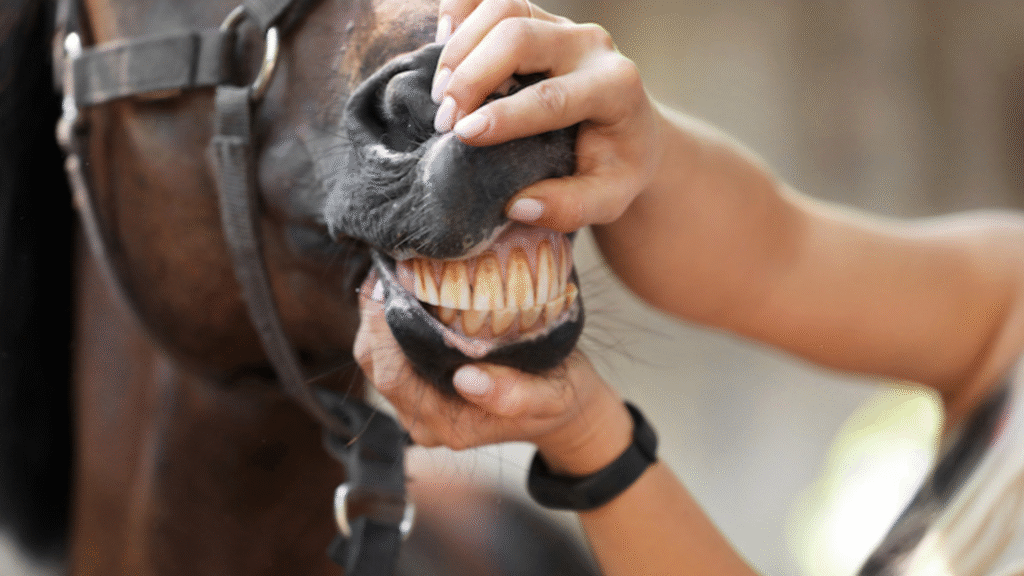
Estimating age by teeth offers a practical alternative when records are missing because dental eruption and wear follow predictable patterns that correlate with age ranges. Key dental markers—incisor eruption schedules, the disappearance of cups, the appearance of Galvayne’s groove, and changes to tooth angle and wear—allow experienced observers to place horses into age bands with reasonable confidence.
This section includes a compact table summarizing dental signs with age ranges and reliability notes, followed by practical check steps and a caveat about environmental and dietary effects on tooth wear. When precision is required, combine dental assessment with other indicators or seek a veterinarian’s evaluation.
| Dental sign | Age range indicated | Reliability/notes |
| Incisor eruption (central, intermediate, corner) | 0–5 years | High reliability for young horses; eruption schedule is predictable |
| Cups disappearance (infundibulum wear) | 6–11 years | Moderate reliability; diet and wear affect timing |
| Galvayne’s groove appearance | ~10–30 years | Useful for mid-to-late ages but varies by individual |
| Tooth angle & wear patterns | Adult to senior years | Indicative for older horses but influenced by feed type |
Dental checks provide practical, field-ready age estimates, but they are influenced by diet and management so should be combined with chart methods and veterinary input when exact age matters.
What Are the Key Dental Features Used to Determine Horse Age?
Key features include the eruption timing of central, intermediate, and corner incisors; the gradual disappearance of enamel cups; the emergence and progression of Galvayne’s groove; and changes in tooth angle and surface shape with wear. Each marker aligns with specific age bands: eruption events are most reliable in foals and yearlings, while wear patterns and grooves provide clues through adulthood and into senior years. Observing multiple markers together increases accuracy because any single sign may be accelerated or delayed by diet, chewing patterns, or prior dental work. Use these dental cues as a corroborating method alongside chart-based conversion for best results.
How Reliable Is Dental Aging Compared to Year-Based Conversion?
Dental aging is practical and often more accurate than simple year-based conversion when records are absent, particularly for horses under ten years old where eruption events are clear. However, reliability declines with older horses because tooth wear is affected by forage type, dental care history, and individual variation, which can misplace a horse by several years if taken alone.
Therefore, combine dental assessment with staged multiplier formulas and consider radiographic or veterinary assessment when precise age impacts medical or legal decisions. When in doubt, rely on a veterinarian to reconcile chart estimates and dental findings into a single, defensible age approximation.
Conclusion
Understanding how to convert horse years to human years is essential for effective equine care, enabling owners to tailor training and health management to their horse’s life stage. By utilizing practical formulas and recognizing key developmental milestones, you can make informed decisions that enhance your horse’s well-being. Explore our resources for more insights on equine care and age estimation techniques. Take the next step in optimizing your horse’s health by accessing our comprehensive guides today.
Frequently Asked Questions
What are the common myths about horse age conversion?
One prevalent myth is the “multiply by seven” rule, which oversimplifies the conversion of horse years to human years. This approach fails to account for the unique developmental stages of horses, particularly in their early years when they mature much faster than humans. Instead, a more accurate method involves using stepped multipliers that reflect the rapid growth in the first few years and a slower aging process thereafter. Understanding these nuances helps owners make better care decisions based on their horse’s actual age.
How can I tell if my horse is aging well?
Monitoring your horse’s overall health and behavior is key to assessing aging. Look for signs such as weight maintenance, energy levels, and dental health. Regular veterinary check-ups can help identify age-related issues early, such as arthritis or dental problems. Additionally, observe your horse’s mobility and willingness to engage in activities. A well-maintained diet and appropriate exercise can significantly contribute to a horse’s quality of life as it ages, ensuring it remains healthy and active for as long as possible.
Are there specific breeds known for longevity?
Yes, certain horse breeds are recognized for their longevity. Generally, smaller breeds and ponies tend to live longer than larger breeds. For example, breeds like the Arabian and the Appaloosa are known for their resilience and can often live into their 30s with proper care. In contrast, larger breeds, such as draft horses, may have shorter lifespans due to their size and associated health risks. Understanding breed-specific traits can help owners plan better for their horse’s long-term care and management.
What role does exercise play in a horse’s lifespan?
Regular, appropriate exercise is crucial for maintaining a horse’s physical health and longevity. It helps manage weight, supports cardiovascular health, and promotes mental well-being. However, the intensity and type of exercise should be tailored to the horse’s age and physical condition. Overworking a horse, especially as it ages, can lead to injuries and accelerate wear on joints. A balanced exercise regimen, combined with rest and recovery, can enhance a horse’s quality of life and extend its healthy years.
How can I adjust my horse’s diet as it ages?
As horses age, their nutritional needs change significantly. Older horses may require diets that are higher in fiber and lower in sugar and starch to support digestive health. Additionally, they may benefit from supplements that promote joint health and overall vitality. Regular dental check-ups are essential, as dental issues can affect a horse’s ability to chew and digest food properly. Consulting with a veterinarian or equine nutritionist can help tailor a diet that meets the specific needs of an aging horse.
What are the signs of age-related health issues in horses?
Common signs of age-related health issues in horses include weight loss, changes in appetite, dental problems, decreased energy levels, and stiffness or lameness. Additionally, older horses may exhibit behavioral changes, such as increased irritability or reluctance to engage in activities they once enjoyed. Regular veterinary check-ups are vital for early detection of these issues, allowing for timely interventions that can improve the horse’s quality of life and longevity.