
Horses can and do horses sleep standing up, but that answer needs context: standing sleep is primarily slow wave sleep (SWS) enabled by a specialized anatomical mechanism called the stay apparatus, while true rapid eye movement (REM) sleep requires the horse to lie down. This article explains the mechanics, stages, and daily patterns of equine sleep so owners can recognize normal rest versus signs of deprivation.
You will learn how much sleep horses typically get, why foals differ from adults, and how herd dynamics and stall design influence lying time. Practical guidance covers how to spot sleep problems, actionable stalls and bedding recommendations, and quick checks to help decide when veterinary assessment is warranted. The sections below compare standing versus recumbent sleep, map sleep stages with a concise EAV table, explore evolutionary reasons for standing rest, and offer a clear prevention checklist to protect your horse’s sleep health.
How Do Horses Sleep: Standing vs. Lying Down Sleep Patterns Explained
Do horses sleep standing up, and lying sleep serves different physiological functions: standing sleep (SWS) lets a horse rest with minimal muscular effort using the stay apparatus, while lying down enables REM sleep with its characteristic muscle atonia and deeper brain activity. Current research indicates horses average short, polyphasic sleep across 24 hours, with only a small portion in REM that requires recumbency, so owners should expect frequent short rests rather than a single long sleep.
The following table contrasts standing and lying sleep by stage and primary benefit to make the practical differences clear for quick reference.
This table compares the two primary rest positions and their functional outcomes.
| Position | Sleep Stage | Typical Duration / Benefit |
| Standing (recumbent absent) | Slow Wave Sleep (SWS) | Multiple short bouts totaling most of daily rest; conserves energy and allows quick escape |
| Lying down (recumbent) | REM Sleep | Short daily totals (minutes) responsible for memory consolidation and emotional regulation |
| Alternating posture | Combined SWS + REM | Balanced restorative sleep when environment is safe and herd dynamics permit |
The comparison shows that while standing sleep dominates in duration, lying bouts are essential for full restoration, which leads into a closer look at the stay apparatus that enables standing rest.
What Is Standing Sleep and How Does the Stay Apparatus Work?
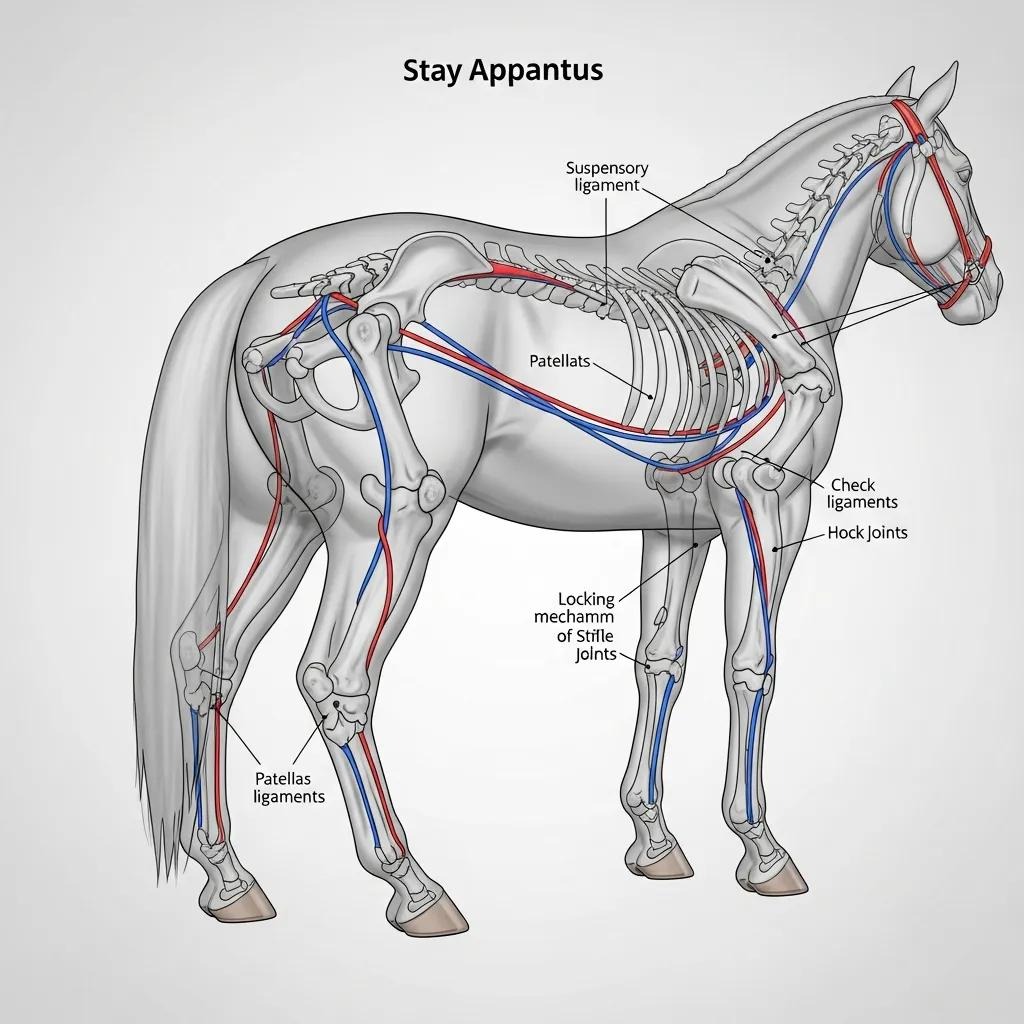
Standing sleep depends on the stay apparatus, an arrangement of tendons, ligaments, and the patella that locks a limb so muscles can relax while the horse remains upright. Anatomically, the patellar mechanism engages with the femoral trochlea and supporting ligaments to stabilize the limb, reducing metabolic cost and allowing the horse to enter SWS without constant muscular effort. This mechanism enables rapid activation for flight if a predator or perceived threat appears, which is a key survival advantage. Understanding this mechanical support clarifies why standing sleep is common but incomplete compared with recumbent REM.
The Equine Stay Apparatus: Enabling Standing Sleep in Horses
The passive stay apparatus of horses is a complex mechanism that allows them to stand with minimal muscular effort. This apparatus is composed of ligaments and tendons that lock the joints in the limbs, enabling horses to sleep while standing.
Effect of differences in tendon properties on functionality of the passive stay apparatus in horses, 2011
The stay apparatus allows horses to enter a light sleep while standing, conserving energy and maintaining vigilance.
Do horses sleep standing up and Lying Down: Understanding Equine Rest States
The answer is both, horses can sleep standing up or lying down. AnimalWised learns more about what horse sleeping positions mean and how they affect their well-being.
Horses use an anatomical mechanism which is known as thestay apparatus. This is a passive stance which is afforded by the arrangement of muscles, ligaments and tendons working together to keep a horse in a standing position. By these body parts locking together, the horse can enter a light sleep while standing without the risk of falling over.
When sleeping standing up, horses only enter a phase oflight sleep or dozing. While they are resting and conserving energy, they are not completely shut off from their surroundings. They may have their eyes closed, but their ears and other sensory organs are able to detect various stimuli. This allows them to make a quick evasion if they detect a predator approaching or if another horse gives them a warning.
Do Horses Sleep standing up or Lying Down?
Why Do Horses Need to Lie Down for REM Sleep?
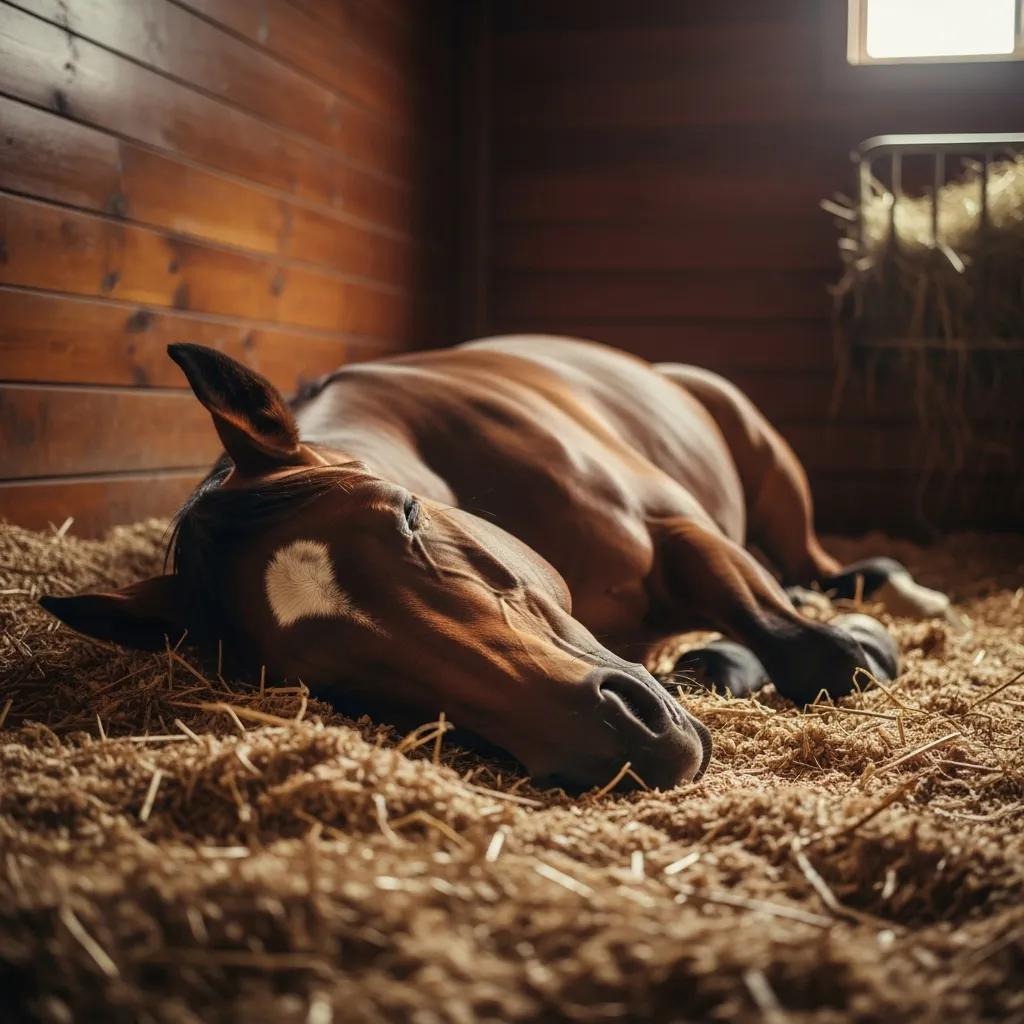
REM sleep requires generalized muscle atonia and specific brain-state patterns that cannot occur safely while weight-bearing on limbs, which is why horses lie flat or in sternal recumbency to achieve REM. Typical REM totals are brief—often measured in minutes spread across several recumbent episodes—and deprivation of REM can impair cognitive processing and lead to abnormal behaviors or collapse. Because REM is short but critical, owners should monitor for regular short lying bouts; insufficient recumbency is a red flag that points to pain, insecurity, or social stress and should be investigated.
Foreleg Stay Apparatus: Key to Equine Standing Rest
The function of the stay apparatus of the equine foreleg is crucial for allowing horses to rest in a standing position. This anatomical adaptation minimizes the need for active muscle engagement, facilitating prolonged periods of standing sleep.
Evolutionary and functional morphology of the shoulder region and stay-apparatus in fossil and extant horses (Equidae), BJ MacFadden, 1992. While standing sleep is possible due to the stay apparatus, it is insufficient for complete sleep cycles.
Why Horses Need to Lie Down for Complete Sleep Cycles
Importantly, complete loss of muscle tone during paradoxical sleep is consistent. A horse cannot complete a sleep cycle while standing. Horses that cannot lie down will be sleep-
10 Sleep and Sleep Disorders in Horses, 2015
What Are the Key Stages of Horse Sleep and How Long Do They Sleep?
Horses exhibit a polyphasic sleep architecture composed of wakefulness, SWS, and REM, with most time spent awake or in SWS and only a small fraction in REM. This organization supports prey-animal vigilance while preserving restorative functions through distributed short episodes, meaning horses accumulate sleep across the day and night rather than in one block. Average total sleep time often ranges around 3–5 hours per 24-hour period with REM minutes varying by age and condition, and the table below outlines each stage with its key characteristic and importance for health.
The table below summarizes sleep stages, primary characteristics, and their functional importance.
| Sleep Stage | Characteristic | Effect / Importance |
| Wakefulness | High alertness and activity | Enables feeding, social interaction, and vigilance |
| Slow Wave Sleep (SWS) | Reduced brain activity with partial disengagement | Physical rest, metabolic recovery, maintained while standing |
| REM Sleep | High brain activity with muscle atonia | Memory consolidation, emotional regulation, requires recumbency |
This structure explains why polyphasic patterns matter for monitoring; recognizing normal short REM episodes helps distinguish rest from pathology, which leads to practical owner-level observations of REM amounts.
How Much REM Sleep Do Horses Get and Why Is It Important?
REM sleep in adult horses is brief but functionally vital, commonly totaling around 20 minutes to an hour spread over several short recumbent episodes across 24 hours, depending on age and environment. REM supports neural processing, learning, and emotional stability; foals, for example, spend more time in REM, reflecting developmental needs. Practically, a consistent absence of lying REM episodes or repeated collapse-like events indicates sleep deprivation or underlying neurologic/pain issues and should prompt veterinary evaluation to protect welfare and performance.
What Is Polyphasic Sleep and How Does It Affect Horse Rest?
Polyphasic sleep means horses take multiple short naps (SWS and occasional REM) rather than a single consolidated sleep period, often synchronized to herd routines and environmental cues. Owners may misinterpret brief dozing as lethargy; instead, look for a pattern of frequent short rests interspersed with alert activity and occasional lying bouts. Managing lighting, feeding schedules, and stable calmness supports healthy polyphasic patterns, and understanding the rhythm helps differentiate normal variability from insomnia or stress-related sleep loss.
Why Do Horses Sleep Standing Up? Evolutionary and Survival Reasons
Standing sleep evolved as a survival adaptation for prey animals: remaining upright with the ability for rapid escape reduces predation risk while still allowing metabolic recovery through SWS. Herd dynamics also support this strategy—individuals can take turns lying down while others remain vigilant—which distributes risk across group members. The stay apparatus provides the mechanical means to benefit from standing rest, but this trade-off sacrifices full REM unless the horse feels secure enough to lie down, so owners must create conditions that permit safe recumbency when needed.
- Horses use herd sentinel behavior to reduce individual vulnerability during recumbency.
- Standing sleep allows faster escape responses than lying down, which can be life-saving in natural settings.
- Secure environments with low perceived risk increase the frequency and duration of recumbent REM.
Equine Passive Stay Apparatus: Biomechanics of Standing Sleep
The passive stay apparatus (PSA) in horses is an example of an efficient biomechanical strategy that allows them to remain standing with minimal energy expenditure. This mechanism is fundamental to understanding how horses achieve rest, including sleep, while standing.
Ontogeny of Morphological Adaptations in the Passive Stay Apparatus of Chilean Horses: Implications for Key Phylogenetic Structures., P Medina-González, 2025
How Does Being a Prey Animal Influence Horse Sleep Behavior?
As prey animals, horses prioritize vigilance and quick flight over long, deep sleep; this ecological pressure shapes short naps and guarded recumbency strategies in herds. Owners should observe turn-taking in lying behavior where one or two horses remain alert while others rest; disruption of this pattern (for example by a new animal or persistent noise) reduces lying time and therefore REM opportunities. Minimizing disturbances and allowing a consistent herd composition supports natural sleep-sharing behaviors and improves overall rest.
The stay apparatus provides mechanical locking of limb joints via tendons, ligaments, and patellar engagement, which significantly reduces muscular energy expenditure during standing rest. Advantages include energy conservation, quick transition to flight, and reduced fatigue during long standing periods, but the mechanism cannot produce the muscle atonia required for REM. Recognizing this limitation clarifies why safe lying areas and comfortable bedding remain essential components of equine care to ensure full restorative sleep.
How Can You Recognize and Prevent Sleep Problems in Horses?
Identifying sleep problems early requires knowing common signs, likely causes, and clear prevention steps so owners can act before severe deprivation occurs. Observe daily patterns for reduced lying time, excessive daytime drowsiness, unexplained injuries, or episodes of collapse—these are prominent warning signs. Prevention centers on addressing pain, securing the environment, optimizing bedding and stall design, and managing social stressors to restore normal SWS/REM balance. The brief resource note below is provided for readers who manage equine enterprises and may need specialized support.
The checklist and lists that follow make practical prevention straightforward for caretakers.
Signs and causes list intro paragraph: Use the items below to recognize common clinical and management causes of equine sleep deprivation. Observe behavior changes and act early for welfare protection.
- Reduced lying time: The horse rarely adopts recumbent positions during overnight observation.
- Excessive daytime nodding or stumbling: Repeated microsleeps or inattentive behavior during rest periods.
- Sudden collapse or loss of balance: A red flag requiring immediate veterinary assessment.
- Unexplained injuries or poor performance: Can result from impaired reflexes due to sleep loss.
These signs point to causes that range from pain and colic to environmental insecurity, and identifying the root cause is the first step toward prevention.
What Are the Signs and Causes of Equine Sleep Deprivation?
Sleep-deprived horses may show frequent head nodding, poor coordination, decreased responsiveness, and a reluctance to lie down, while severe cases can involve collapse or behavioral instability. Common causes include discomfort from lameness or ulcers, noisy or brightly lit stables, bullying by herd mates, and inadequate bedding that discourages recumbency. Owners should monitor lying time quantitatively and consult a veterinarian when red flags like collapse occur, since underlying medical issues often present as sleep disruption. Early detection and targeted management restore normal sleep patterns and reduce welfare risks.
How Can You Create an Ideal Sleep Environment for Your Horse?
Create an environment that promotes safe recumbency by ensuring a quiet, dimly lit stall with comfortable, dust-minimized bedding, adequate stall size, and stable social groupings so horses feel secure enough to lie down. Recommended bedding types include clean straw or shavings with sufficient depth to cushion joints; avoid surfaces that are slippery or thinly layered since these reduce lying time. Manage lighting to mimic natural dusk-to-dawn cycles and reduce sudden nighttime disturbances by minimizing alarm sounds and secure fencing to prevent startling. A short resource mention follows for owners running equine businesses.
These measures collectively encourage REM opportunities and help maintain both physical and cognitive health in horses.
Conclusion
Understanding how horses sleep, both standing and lying down, is crucial for their health and well-being. By recognizing the importance of REM sleep and the role of the stay apparatus, owners can create environments that support optimal rest. Monitoring sleep patterns and addressing potential issues early can significantly enhance a horse’s quality of life. For more insights and resources on equine care, explore our comprehensive guides today.
Frequently Asked Questions
1. How can I tell if my horse is getting enough sleep?
To determine if your horse is getting adequate sleep, observe its lying behavior and overall alertness. Healthy horses typically lie down for short periods throughout the day and night, accumulating around 3-5 hours of sleep. Look for signs of excessive daytime drowsiness, frequent head nodding, or reluctance to lie down, which may indicate sleep deprivation. Regularly monitoring these behaviors can help you assess your horse’s sleep health and identify any potential issues early.
2. What should I do if my horse refuses to lie down?
If your horse is reluctant to lie down, it may be experiencing discomfort, stress, or insecurity. First, assess its environment for potential stressors, such as noise, lighting, or bullying from other horses. Ensure the stall is comfortable and safe, with appropriate bedding. If the behavior persists, consult a veterinarian to rule out underlying medical issues, such as pain or illness, that could be affecting your horse’s willingness to rest properly.
3. Are there specific bedding types that promote better sleep for horses?
Yes, the right bedding can significantly enhance a horse’s sleep quality. Recommended bedding types include clean straw or shavings, which provide cushioning and comfort. Ensure the bedding is deep enough to support the horse’s joints and minimize pressure points. Avoid slippery or thin bedding, as these can discourage lying down. A clean, dust-free environment also contributes to better respiratory health, further supporting restful sleep.
4. How does herd behavior influence a horse’s sleep patterns?
Herd dynamics play a crucial role in a horse’s sleep patterns. Horses are prey animals and rely on their herd for safety while resting. Typically, some horses will remain alert while others lie down, allowing for shared vigilance. Disruptions in herd composition or the introduction of new animals can affect this behavior, leading to reduced lying time and REM sleep. Maintaining a stable social group can help promote natural sleep-sharing behaviors.
5. What are the long-term effects of sleep deprivation in horses?
Long-term sleep deprivation in horses can lead to serious health issues, including impaired cognitive function, emotional instability, and increased susceptibility to injuries. Chronic lack of REM sleep can affect memory consolidation and emotional regulation, potentially resulting in behavioral problems. Additionally, sleep-deprived horses may exhibit decreased performance and coordination. Early detection and intervention are essential to prevent these negative outcomes and ensure the horse’s overall well-being.
6. Can environmental factors affect my horse’s sleep quality?
Absolutely, environmental factors significantly impact a horse’s sleep quality. Elements such as noise, lighting, and stall design can either promote or hinder restful sleep. A quiet, dimly lit stall with comfortable bedding encourages horses to lie down and achieve REM sleep. Conversely, bright lights or loud noises can create stress, making horses reluctant to rest. Ensuring a calm and secure environment is vital for optimal sleep health.
7. What are the signs of sleep problems in horses?
Signs of sleep problems in horses include reduced lying time, excessive daytime drowsiness, and unusual behaviors such as head nodding or stumbling. Severe cases may involve sudden collapse or loss of balance, which require immediate veterinary attention. Other indicators can include unexplained injuries or poor performance, often linked to impaired reflexes due to sleep loss. Monitoring these signs closely can help you address potential issues before they escalate.